
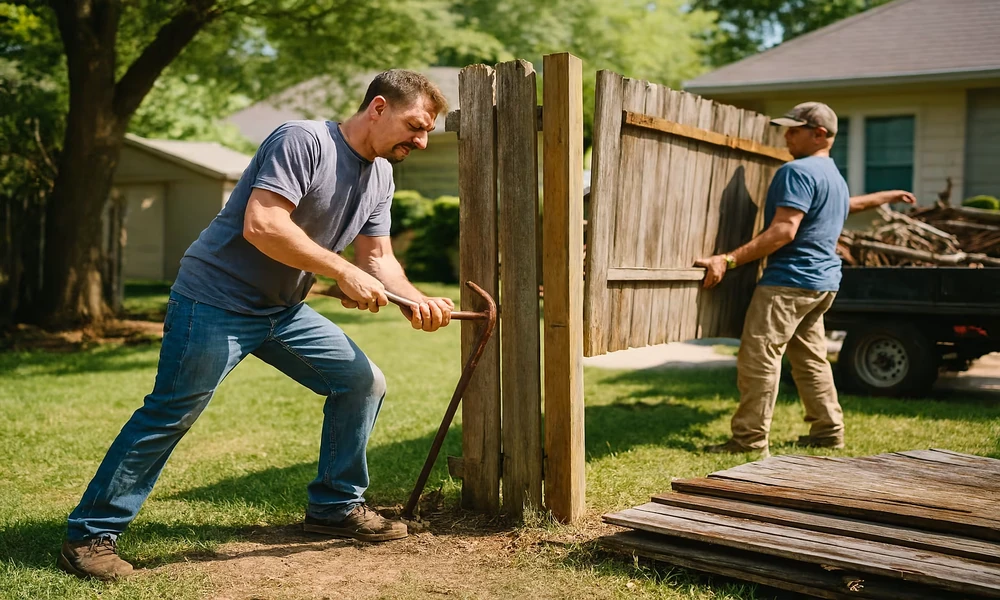
Most homeowners spend plenty of time choosing their new garden fence. They’ll compare timber panels, look at different post styles and work out how much they want to spend.
Very few give much thought to getting the old one out.
That’s often where the real work begins.
I’ve seen fencing jobs around Leeds where removing the existing boundary took longer than installing its replacement. Not because anything went particularly wrong, but because the original posts had been buried in enormous concrete foundations, old tree roots had grown around them or access was so restricted that everything had to be carried through the house.
When people request quotes for garden fencing in Leeds, they’re sometimes surprised by how much of the cost relates to work they’ll never see once the job is finished.
It’s worth understanding what you’re actually paying for.
The Old Fence Rarely Comes Out Easily
A fence that’s been standing for fifteen or twenty years has usually become part of the garden.
Soil builds up around the bottom. Plants grow through panels. Concrete foundations settle into the surrounding ground. Sometimes previous owners have added paving, decking or raised beds without considering how the fence might eventually be replaced.
Then somebody decides it’s time for a new boundary.
Removing the panels is often straightforward. A few screws, some old nails and a bit of persuasion usually deal with those.
The posts are another matter.
I’ve worked on jobs where a single concrete footing weighed considerably more than expected. You dig around it, thinking you’re nearly finished, only to discover another 200mm of concrete underneath.
And another lump sticking out sideways.
There’s no clever trick that makes it disappear. Somebody has to break it up or lift it out.
That takes time.
Old Concrete Can Be a Bigger Job Than New Concrete
People often assume that because the original fence was installed years ago, its foundations must be weak.
Sometimes they are.
Other times they’re incredibly solid.
I’ve removed rotten timber posts surrounded by concrete that was still perfectly sound. The wood had failed, but the foundation hadn’t moved an inch.
Getting that concrete out without damaging nearby paving or drainage can be awkward.
On some jobs, mechanical breakers are needed. On others, there’s barely enough room to swing a digging bar.
Heavy clay soil makes things worse.
Around parts of Leeds and Bradford, clay can grip old concrete foundations tightly, particularly when the ground has been wet for weeks.
You end up digging a much larger hole than expected just to free one footing.
Multiply that by ten or twelve posts and the removal work becomes a substantial part of the project.
Restricted Access Changes Everything
This is probably one of the most underestimated fencing costs.
A detached property with a wide side entrance is relatively easy to work on. Materials come in, waste goes out and tools can be moved around without too much trouble.
Now imagine a terraced house with no rear access.
Everything has to pass through the property.
Old panels need carrying out carefully. Broken concrete must be removed in manageable pieces. New posts, gravel boards, panels and bags of concrete all have to come back through.
If there’s a narrow kitchen, freshly decorated hallway or awkward set of steps, the work becomes slower still.
Some properties have access through neighbouring gardens, but that requires permission and isn’t always practical.
I’ve encountered gardens where the only realistic option was carrying every single piece of waste through the house by hand.
That isn’t a minor detail when pricing a job.
It’s hours of additional labour.
The Garden Might Be Hiding More Than You Think
Older gardens have a habit of collecting things underground.
Broken bricks.
Old paving slabs.
Buried fence posts.
Concrete from previous extensions.
Occasionally, entire sections of an earlier boundary have been buried rather than removed.
I’ve dug post holes and found two or three generations of fencing foundations in roughly the same place.
Each time the fence was replaced, somebody had moved the new posts slightly to avoid the old concrete.
Eventually there wasn’t much clear ground left.
This is especially common where boundaries have been altered over the years.
It creates a problem for the next installation because post spacing and positioning can’t always be adjusted without affecting the finished fence.
Sometimes the old material has to come out properly.
There’s also the question of buried services. Cables, drainage pipes and water supplies may run close to garden boundaries. Their position should be checked before excavation, rather than discovered with a digging bar.
Waste Disposal Isn’t Free
A surprising number of homeowners underestimate how much waste comes from replacing a fence.
Take a typical garden with ten bays of timber fencing.
That’s ten old panels, potentially eleven posts, gravel boards, fixings and whatever concrete comes out of the ground.
It adds up quickly.
Old timber is often too rotten or damaged to reuse. Concrete needs separating from other waste. Metal fixings may need removing, and vegetation tangled through the fencing creates another pile.
Then everything has to be loaded, transported and disposed of through an appropriate waste route.
Commercial waste disposal costs money.
So does the time spent loading and unloading it.
Some homeowners offer to dispose of the old fencing themselves to reduce the quote. That can work, provided they understand the quantity involved and have a suitable way to handle it.
A few rotten panels might fit into a hired skip.
Several tonnes of concrete and timber are another matter.
Ivy Can Turn a Simple Job Into a Nightmare
Ivy looks harmless when it’s young.
Twenty years later, it can become a serious obstacle.
I’ve seen entire fence runs hidden beneath thick, mature growth. The plants have wrapped themselves around posts, grown through rails and become so tangled that removing a panel without first cutting everything back is impossible.
The weight can be remarkable.
And when ivy is wet, it’s even worse.
Sometimes the plant is effectively holding a rotten fence together. Start removing the growth and the structure underneath begins falling apart.
There’s also the issue of neighbouring plants.
If ivy or climbing shrubs belong to the property next door, you can’t simply destroy them to make the work easier.
The job needs planning.
In some cases, vegetation clearance should happen well before the fencing contractor arrives. Active bird nests also need protecting, which can affect when clearance work takes place.
Leaving everything until installation day is asking for delays.
Paving and Decking Can Make Replacement Expensive
Garden landscaping often gets installed after the fencing.
That’s understandable. People improve their gardens gradually.
The problem comes when patios, decking or raised beds are built tightly around existing fence posts.
Years later, those posts need replacing.
Suddenly there’s no room to excavate.
Sometimes paving slabs can be lifted and reinstated without much trouble. Other times, cutting or removing part of the surrounding surface becomes unavoidable.
Decking presents similar problems.
If the framework runs close to the boundary, there may be no practical access to the original foundations.
I’ve seen homeowners spend thousands creating beautiful outdoor spaces without leaving any realistic way to maintain the fencing behind them.
It looks fantastic until something fails.
Then a relatively straightforward fencing replacement becomes a much bigger project.
Can You Reuse Existing Fence Posts?
Sometimes.
But I’d be cautious.
If concrete posts are straight, structurally sound and correctly spaced, retaining them can save considerable money.
The same can occasionally apply to good timber posts.
The important thing is checking their condition properly.
A timber post might look perfectly healthy above ground while deteriorating badly around the soil line.
That’s where rot often develops.
I’ve seen people fit expensive new panels between ageing posts to save money, only to replace the entire lot a couple of winters later.
It makes little sense.
If the posts are genuinely sound, reuse them.
If they’re questionable, deal with them while the fence is already dismantled.
Paying twice for labour is rarely a saving.
Why Some Fencing Quotes Look So Different
Homeowners sometimes receive two quotes for what appears to be exactly the same job.
One is considerably cheaper.
That doesn’t automatically mean the more expensive contractor is better. But it does mean the quotes need examining properly.
Has removal of the existing fencing been included?
What happens to the concrete foundations?
Is waste disposal covered?
Will the contractor remove old posts completely or work around them?
Are damaged paving and landscaping excluded?
These details matter.
A quote for installing ten new panels onto prepared ground is very different from one that includes dismantling an old fence, excavating foundations, removing waste and making the area ready for installation.
Both might describe the work as replacing a garden fence.
They’re not necessarily pricing the same job.
Before choosing between local fencing contractors, make sure everyone has allowed for the same removal and groundwork.
Otherwise the cheapest quote may simply be the least complete.
Winter Ground Conditions Can Add Labour
Late autumn and winter are perfectly reasonable times to replace fencing.
But ground conditions can affect the work.
Waterlogged clay is heavy and messy. Excavated holes may collect water. Moving materials across saturated lawns can damage the surface.
Frozen ground presents different difficulties.
I’ve worked through plenty of cold Yorkshire mornings where digging was considerably harder than it would have been a few months earlier.
That doesn’t mean homeowners should automatically wait until spring.
A dangerous or badly damaged fence shouldn’t be left standing simply because the weather is inconvenient.
It does mean allowing for realistic working conditions.
Sometimes protecting the garden takes almost as much thought as installing the fence itself.
Removing Your Own Fence Might Save Money
For homeowners comfortable with practical work, removing old panels before the contractor arrives can reduce labour costs.
But I’d draw a distinction between dismantling panels and excavating foundations.
Taking down lightweight timber panels is often manageable with basic tools and suitable safety precautions.
Removing large concrete footings is physically demanding and carries more risk.
There may be buried cables, sharp metal fixings, unstable structures and heavy materials to handle.
I’ve also arrived at properties where homeowners had started dismantling a fence, discovered how difficult the posts were to remove and left everything half-finished.
That can make the remaining work harder.
If you’re considering doing part of the removal yourself, agree exactly what needs to be completed before installation starts.
A contractor expecting clear ground won’t be delighted to find eleven concrete foundations still buried beneath it.
Good Planning Keeps Costs Under Control
The easiest way to avoid unexpected removal costs is to inspect the existing boundary properly before work begins.
Check access.
Look for buried gravel boards.
Identify paving and raised beds near posts.
Consider how much vegetation needs clearing.
Find out whether existing foundations can realistically be removed.
Most importantly, allow enough time.
Rushing demolition usually creates more problems than it solves.
A careful removal also protects things that are staying, including neighbouring fences, garden structures and established planting.
That’s particularly important in smaller Leeds gardens where there may be very little room to work.
The last thing anyone wants is to replace a fence and then pay to repair the patio beside it.
The Work You Never See Often Matters Most
There’s something satisfying about looking at a newly installed fence.
Straight panels. Solid posts. Clean boundaries.
It can completely change a garden.
But homeowners rarely see the hardest part of the job.
They don’t see the hours spent breaking out old foundations, carrying waste through narrow passages or working around buried obstacles.
By the time the new fence goes up, much of the difficult work has already been completed.
And that’s how it should be.
A properly prepared site gives the replacement fence the best chance of lasting. Old foundations aren’t left causing problems, post positions are chosen sensibly and drainage can be addressed before everything is covered up again.
The new panels might be what everyone notices.
Getting the old fence out properly is what allows the new one to do its job.